
HR teams in Munich often ask me: "Does meditation at work actually do anything, or is it just a nice perk?" Here's what the research says, without the hype, and how to make it work if you try it.
What the research shows
Stress, anxiety and burnout. A 2026 meta-analysis in Health Psychology Review found that workplace mindfulness programmes reduced employees' perceived stress, anxiety and burnout. This is the most consistent finding across studies.
Work performance. A 2025 meta-analysis in Stress and Health (Vainre et al.) pooled 99 randomised controlled trials with more than 16,000 participants. Mindfulness programmes showed a small improvement in task performance compared with doing nothing. Compared with other active programmes, like exercise or relaxation training, there was no clear difference. The authors rated their confidence in the evidence as very low.
| Claim | What the evidence says |
|---|---|
| Less stress | Supported, modest effect |
| Less anxiety and burnout | Supported, modest effect |
| Better performance or productivity | Weak; small gain vs no programme, none vs other programmes |
| Fewer sick days, higher ROI | Not reliably shown |
What this means for you: offer meditation because it helps people feel less stressed, not because it will raise output. That's still a good reason, and it's an honest one to give leadership.
Formats that fit a real office
| Format | Length | Best for |
|---|---|---|
| Meeting-room reset | 10 min | Before a big meeting or mid-afternoon |
| Lunchtime meditation | 20-30 min | A weekly habit, highest turnout |
| Pilates with breathwork | 45 min | Desk workers with stiff backs and shoulders |
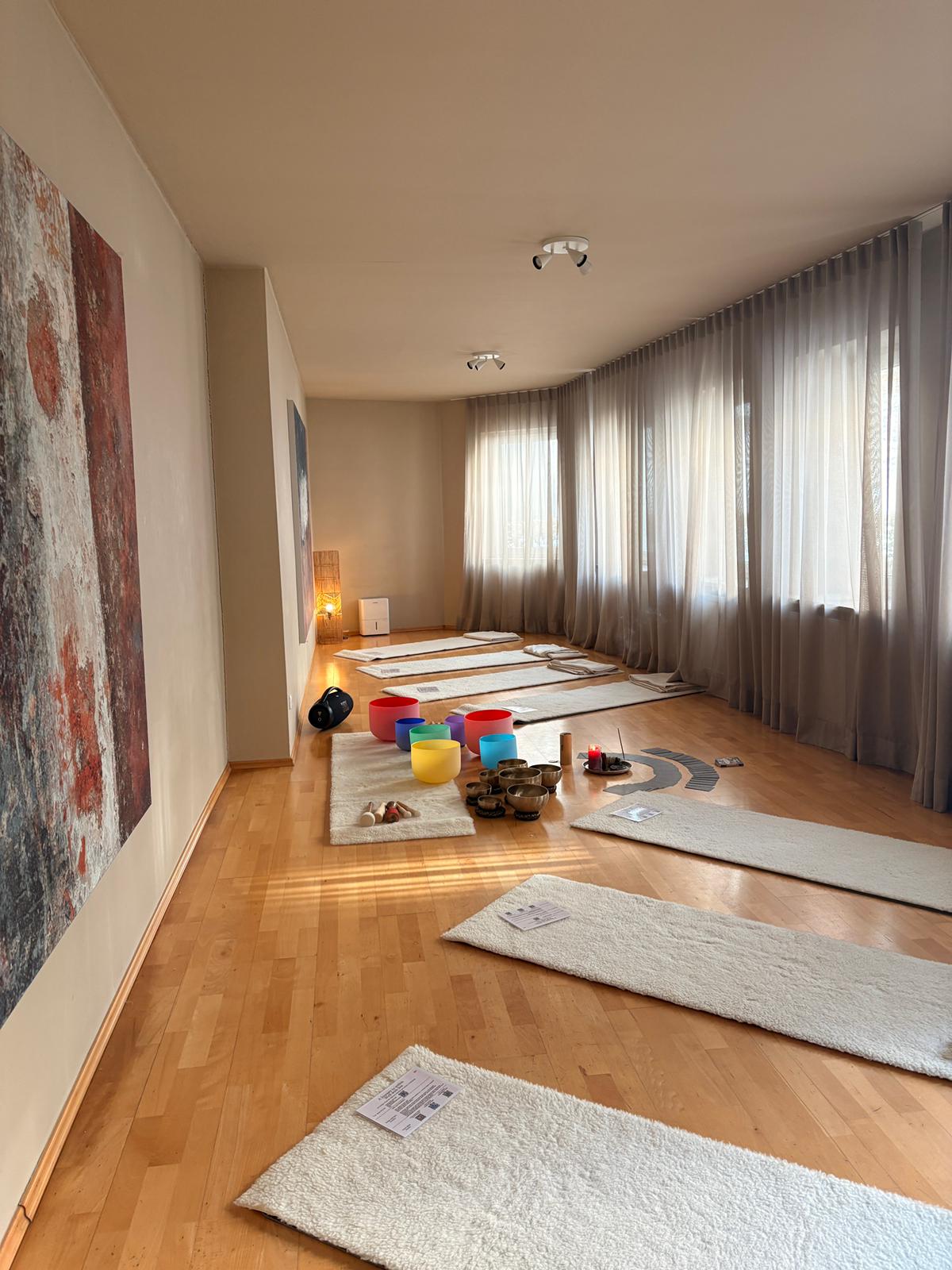
| Sound bath | 60 min | A first experience, wellbeing weeks |
| 4- or 8-week series | 30 min weekly | Building a lasting habit; easiest to measure |
Short and regular beats long and rare. A weekly 20-minute session over 8 weeks gives people time to learn and notice a difference.
How to start in 5 steps
- Ask your team. A two-question poll: would you join, and when?
- Start with a taster. A single 30-minute session or a sound bath lowers the barrier.
- Run an 8-week series at a fixed time, in a quiet room.
- Measure simply. Ask "How stressed do you feel this week (1-10)?" in week 1 and week 8.
- Share results with leadership and decide whether to continue.
What makes it work, and what doesn't
- Do: keep it optional, protect the time in calendars, use the same room, choose a teacher who speaks your team's language.
- Don't: present it as a fix for overwork. Meditation can't replace reasonable workloads, and employees notice when it's used that way.
Why language matters in Munich
Many Munich companies have international teams. If the session is in German only, part of the team either skips it or spends it translating in their head, which isn't relaxing. I teach all my corporate sessions in clear, simple English.